


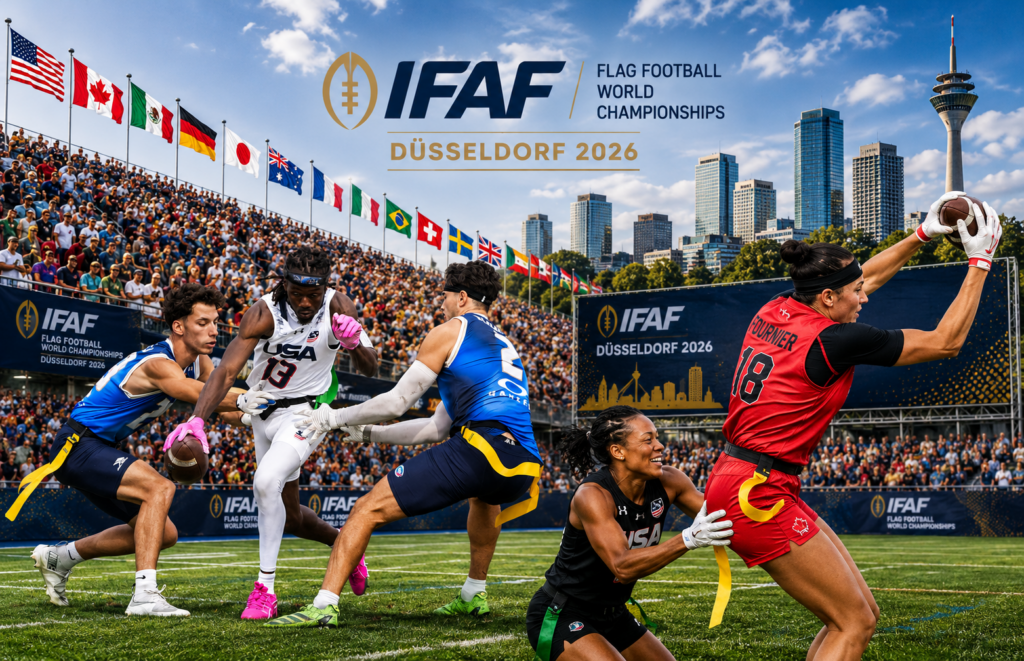
The medals told only part of the story. Düsseldorf showed what flag football can mean to the global future of the entire sport.
The IFAF Flag Football World Championships in Düsseldorf were about much more than who won, who lost and who booked a ticket to Los Angeles. For four days, the game offered a glimpse of what the international future of American football could look like: accessible, fast, inclusive, digitally fluent and capable of filling a venue with supporters from around the world.
This mattered to American football as a whole because the sport has spent decades searching for a truly global doorway. Tackle football remains the game’s most powerful and commercially successful form, but it is expensive, equipment-heavy and difficult to introduce quickly. Flag removes those barriers without removing the football. It gives schools, women and girls, developing federations and countries without a deep tackle tradition an immediate way into the sport.
Düsseldorf connects flag to the football ecosystem
Düsseldorf connected that doorway to the full football ecosystem. Mascots, former NFL players, merchandise, youth activities, food, music and sponsor activations turned the Garath sports complex into something closer to an NFL festival. The Indianapolis Colts, Atlanta Falcons, Kansas City Chiefs, New England Patriots, New York Giants and Seattle Seahawks were represented.
To understand the leap, ask Wayne Neijhorst, in my view the leading authority on flag football in the Netherlands. He coaches the Dutch women’s national team, the Tulips, and for approximately 25 years has taught the game to countless young players and, crucially, their teachers. He attended the 2024 World Championship in Finland and the 2025 European Championships outside Paris.
“I was at the World Championships in Finland,” Neijhorst said. “There were two food trucks, and I think there were 30 people there not playing or being VIPs or whatever. We were at Paris a year ago, and it had none of this.” By contrast, Düsseldorf had full stands for the finals, loud crowds and a festival built around the football. Clips, interviews and analysis flooded social media almost as soon as games ended.
Numbers underline the tournament’s growth
IFAF president Pierre Trochet said the event had reached almost 50 million social-media views by Finals Day, with a potential reach of 140 million. Approximately 20,000 spectators attended across the four days, while 300 volunteers helped deliver the tournament. Neijhorst called the fan experience “absolutely top notch” and characterized the broadcast and streaming production as “splendid.”
The guest list underscored flag’s new standing. IOC president Kirsty Coventry attended alongside NFL Commissioner Roger Goodell, Trochet, North Rhine-Westphalia premier Hendrik Wüst and Düsseldorf mayor Stephan Keller. Former NFL players Markus Kuhn and Sebastian Vollmer were also present. Panama federation president Luis Navas called it “the largest and best Flag Football World Championship in history,” adding: “Everything is perfect.”
Flag enters a new era
For flag football itself, Düsseldorf felt like a coming-of-age ceremony. The event looked professional, was packaged for television and social media, and gave athletes a stage that matched their rapidly improving level. Trochet called it the beginning of “a new era” and stressed that Los Angeles is “part of the journey, not the final destination.” The most revealing statistic was not a score: 42 percent of the games were decided by one touchdown or less. The international game is no longer a procession toward the usual powers. The margins are shrinking.
That depth makes flag especially valuable as a media product. Five-on-five produces constant matchups, creative formations and shareable highlights. Countries are also building distinctive styles rather than merely imitating the United States. Japan’s creativity, Mexico’s movement, Canada’s precision and Europe’s growing tactical confidence enriched the competition.
Growing pains remain
The week was not flawless. Nigeria’s men and women were absent after visa problems, leaving Africa without representation. Questions also surfaced about the visibility and accuracy of the game clock during crucial moments. European programs continue to face major funding disparities. Those are not reasons to temper the sport’s ambition. They are the next problems a maturing international sport must solve.
There is also a less visible concern which should be addressed: European player development has moved faster than coaching development. Most domestic tournaments use a running clock, so coaches rarely receive enough repetitions managing the final minutes under full IFAF timing rules. That inexperience becomes costly when international games are decided by a single possession. France’s women provided a painful example. Leading by four with roughly 40 seconds remaining, they put the ball at risk rather than managing the situation safely and ultimately lost. Better exposure to full-rule games might have produced a different outcome.
Three moments stand out
Three moments will stay with me. First, American Samoa’s men beating the United States 38–32, ending a 14-year American unbeaten run in official IFAF competition. It was not merely an upset. It proved that confidence, preparation and a coherent team identity can overturn the sport’s established order.
Second was the Cinderella run of Slovenia’s women. What remains largely a club-based program, strengthened by a few additions, arrived without the resources of Europe’s leading federations and nearly took down Germany. Slovenia has travelled the long road literally as well as figuratively, driving across Europe to tournaments and building year by year. Its performance captured why international flag is becoming so compelling: a small, committed program can get close enough to make a giant nervous.
The third was the transformation of the tournament itself. The contrast with Finland and Paris was impossible to miss. Düsseldorf did not treat flag as a niche competition that happened to be taking place in town. It treated it as a major international sporting event, advertised it across the city and gave spectators reasons to arrive early and remain between games. That may ultimately be as important as any play on the field.
Düsseldorf offers a glimpse of the future
Düsseldorf did not simply stage the biggest IFAF championship flag tournament yet. It showed American football a plausible global future and showed flag football that it is no longer merely waiting for its Olympic debut. The players have raised their level. The event presentation finally rose with them. If coaching education and funding can follow, the movement Trochet spoke about has already begun.