



The 2026 Chinese National Football League (CNFL) playoffs have delivered dramatic finishes, remarkable comebacks and several dominant performances, but no team has captured the imagination quite like the SuXi Marauders, whose extraordinary run of three consecutive road victories has carried them into the semifinals.
After surviving two nail-biting playoff games with last-minute heroics, the Marauders produced their most emphatic performance yet, crushing the Beijing Barbarians 35–7 in the quarterfinals to continue one of the postseason’s most compelling stories.
The defending champion Beijing Cyclones, Shanghai Warriors and Shanghai Wolves have also advanced, setting up two intriguing semifinal matchups on December 12.
The winners will meet in the CNFL championship game on January 9.
SuXi Marauders complete remarkable three-game road sweep

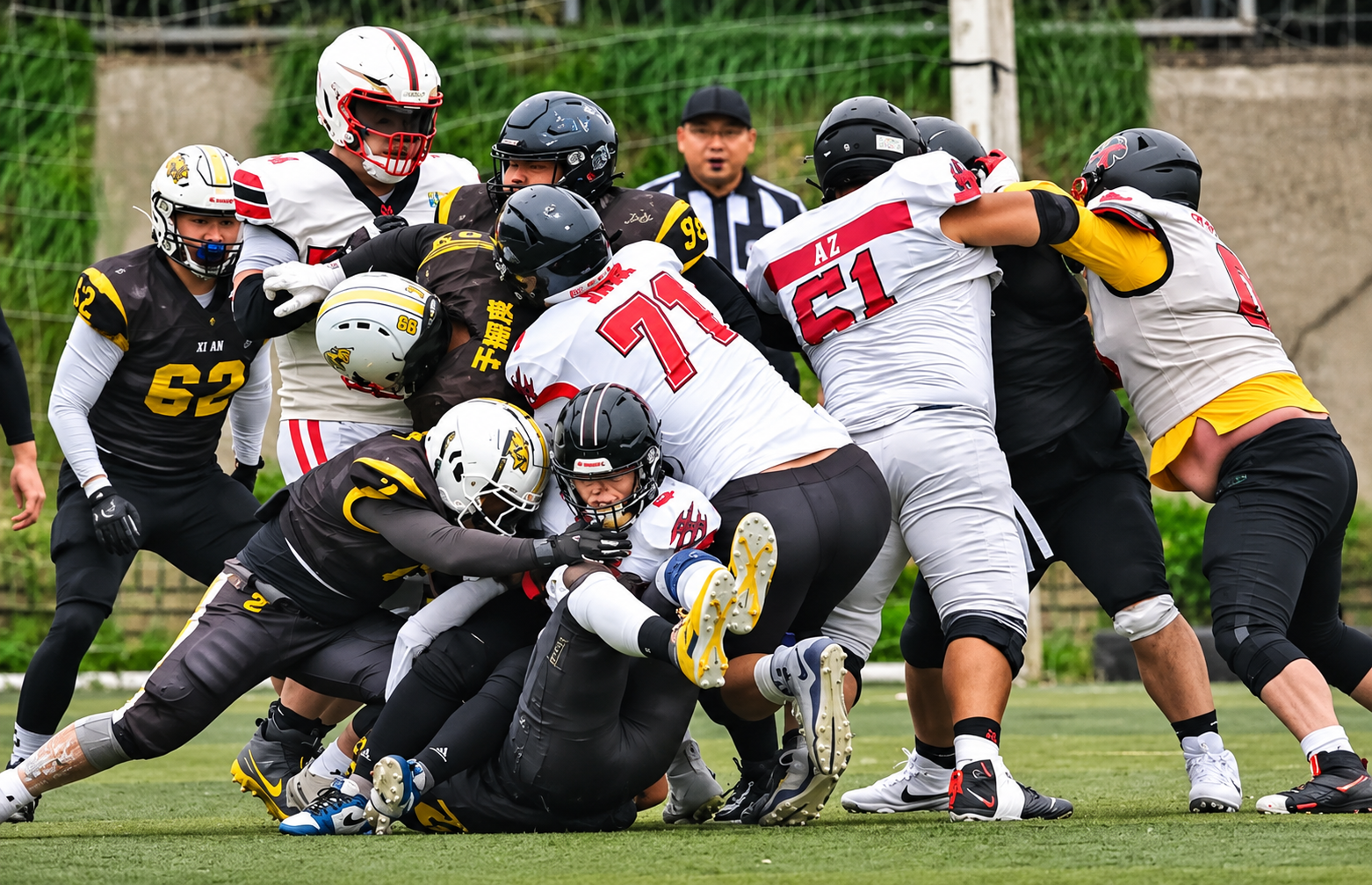
SuXi Marauders (white) battling
The SuXi Marauders entered the playoffs facing a difficult path, with every game requiring them to travel into hostile territory.
Their postseason journey began with a dramatic 35–32 double-overtime victory over the Nanjing Lions in the wildcard round, setting the tone for what would become an extraordinary run.
The Marauders followed that performance with an equally thrilling 22–17 victory over the Xi’an Panthers in the Round of 16, surviving a dramatic goal-line stand on the final play.
Against the Panthers, defensive back No. 27 Kevin Walcott, a former San Diego State Aztecs player, made his presence felt on both sides of the ball, contributing a receiving touchdown and an interception.
Running back No. 3 Chen Sihao (陈司浩) also scored, while kicker No. 44 Yu Kai (于恺) delivered three crucial field goals, including a fourth-quarter kick that extended the Marauders’ lead to 22–14.
The Panthers, led by the outstanding all-around performance of wide receiver No. 30 Abuduwufu’er Abuduhaini (阿布都吾甫尔·阿布都海尼), refused to surrender.
Abuduhaini scored both of Xi’an’s touchdowns, rushing for 113 yards and adding 62 receiving yards.
A late field goal from No. 11 Dilixati Dawutijiang (迪力夏梯·达吾提江) narrowed the deficit to 22–17 before the Panthers defense forced a turnover, giving its offense one final opportunity.
Xi’an marched all the way to the SuXi goal line, but the Marauders broke up a pass on the game’s final play to preserve the victory and reach the quarterfinals for the first time.
After two consecutive games decided in the closing moments, the Marauders took a decidedly different approach in their quarterfinal meeting with the Beijing Barbarians.
Traveling to Beijing for their third straight road playoff game, SuXi overwhelmed the home team 35–7, leaving no doubt about the outcome.
The stunning 28-point victory was particularly impressive considering that the Barbarians had survived a dramatic overtime battle against the Shenzhen Kunpeng in the previous round.
Having demonstrated their ability to win close games under enormous pressure, the Marauders showed they could also dominate a playoff opponent.
Their reward is a December 12 semifinal matchup against the Shanghai Warriors, who have been equally impressive throughout the postseason.
Defending champion Beijing Cyclones continue title defense


Beijing Cyclones offense protecting the quarterback
The defending champion Beijing Cyclones remain firmly in the championship picture after defeating the Chengdu Pandaman 36–23 in the quarterfinals.
The victory ended the playoff run of the West’s last remaining representative and secured a semifinal meeting with the Shanghai Wolves.
The Cyclones had faced a much tougher challenge in the Round of 16, surviving a 41–34 battle against the Gan Cavalry.
The matchup was a rematch of last year’s playoff encounter, which Beijing had won 30–3 after leading just 10–3 at halftime.
This time, the Gan Cavalry proved far more dangerous.
Behind several touchdown passes from quarterback No. 12 Ivan Yang (杨木), the Cyclones built a 27–14 second-quarter advantage and appeared ready to take control.
However, the Gan Cavalry scored twice in the final five minutes of the first half, including a rushing touchdown from wide receiver No. 14 Liao Zebin (廖泽斌), to tie the game at 27–27.
The Cyclones regained control after halftime.
Yang threw his fifth touchdown pass of the game, while wide back No. 84 Cao Yu (曹宇) added a rushing touchdown to extend the lead to 41–27.
Cao began his football career a decade ago with the now-defunct Beijing Iron Brothers, where he played alongside this article’s author.
The Gan Cavalry mounted one final challenge when quarterback No. 13 Min Chao (闵超) threw his second touchdown pass, cutting the deficit to seven points.
However, the Cyclones held firm to secure the victory.
Their subsequent quarterfinal win over Chengdu continued a familiar pattern. The Cyclones had overwhelmed the Pandaman 54–12 in last year’s quarterfinals and once again proved too strong for their western opponents.
Now, Beijing faces a considerably different challenge against the Shanghai Wolves, with a place in the championship game at stake.
Shanghai Wolves survive Hong Kong defensive battle to reach semifinals
The Shanghai Wolves became the first team to secure a place in the CNFL semifinals, defeating the Hong Kong Combat Orcas 14–9 on November 14 in a fiercely contested defensive battle.
The quarterfinal matchup was a rematch of last year’s playoff encounter, which the Wolves had won 8–0, and once again points were difficult to come by.
The Combat Orcas struck first through a short field goal from kicker No. 10 Zhang Tingguang (张庭光).
Their defense then took control, repeatedly frustrating the Shanghai offense and producing a crucial fourth-down stop inside the Hong Kong red zone.
The Combat Orcas carried a 3–0 advantage into halftime, having kept the dangerous Wolves offense off the scoreboard.
However, Shanghai finally broke through in the third quarter.
Quarterback No. 3 Matthew Smith connected with wide receiver No. 14 Yin Qilei (殷其雷) on a deep pass that moved the ball inside the Hong Kong five-yard line.
Smith then fooled the defense on a read-option play and carried the ball into the end zone, giving the Wolves a 6–3 lead after an unsuccessful two-point conversion.
The Combat Orcas answered with a sustained drive sparked by several effective scrambles from quarterback No. 15 Zheng Zhisheng (鄭智升).
Running back No. 9 Ye Jiajun (葉嘉駿) finished the possession with a rushing touchdown, restoring Hong Kong’s advantage.
The missed extra point left the Combat Orcas leading 9–6 entering the fourth quarter.
Both defenses continued to dominate as the clock wound down, but the Wolves remained composed.
With fewer than three minutes remaining, Smith connected with wide receiver No. 45 Shi Shuai (史帅) for the go-ahead touchdown, putting Shanghai ahead 12–9.
Smith then found Yin on the two-point conversion, extending the lead to 14–9 and forcing the Combat Orcas to find a touchdown to keep their season alive.
The Hong Kong offense, however, began to unravel under pressure.
Although Zheng’s mobility helped him escape the relentless Wolves pass rush, led by defensive tackle No. 58 Kyle Finnick, a former New Hampshire Wildcats player, the Shanghai defense successfully neutralized the Combat Orcas’ most dangerous receiving threat.
Zheng finished with 75 rushing yards, but wide receiver No. 0 Zahir Wilder was held to just two receiving yards, although he contributed several useful returns on special teams.
The decisive defensive plays came in the closing minutes.
Smith, pulling double duty at safety, intercepted an errant Zheng pass over the middle to halt a promising Hong Kong possession.
The Combat Orcas defense responded by preventing Shanghai from running out the clock, giving its offense one final opportunity with just under a minute remaining.
But the comeback attempt ended almost immediately when Zheng fumbled and the Wolves recovered.
Shanghai ran out the remaining time to secure the 14–9 victory and advance to the semifinals.
Shanghai Warriors dominate their way into semifinals

Shanghai Warriors defense closing in
The Shanghai Warriors have established themselves as another serious championship contender, following two commanding playoff victories with a 27–6 quarterfinal win over the Shenzhen Buffaloes.
The Warriors had already demonstrated their strength in the Round of 16, shutting out the Jinan Mammoths 41–0.
That contest was a rematch of last year’s playoff meeting, which Shanghai had won 38–8, and this year’s game followed an equally one-sided pattern.
The Warriors established control early, effectively putting the game beyond reach as their deep stable of offensive playmakers took turns finding the end zone.
Running backs No. 34 Zheng Jiajie (郑家杰), No. 91 Wu Yafeng (吴亚锋) and No. 44 Gao Yukai (高煜铠) all scored rushing touchdowns, while wide receiver No. 29 Li Yixin (李亦昕) also contributed a touchdown on the ground.
The Warriors carried that momentum into their quarterfinal meeting with the Buffaloes, holding Shenzhen to just six points in another impressive defensive performance.
The 27–6 victory secured a semifinal meeting with the SuXi Marauders, bringing together two teams that have reached the final four through very different playoff journeys.
While Shanghai has relied on commanding victories, the Marauders have demonstrated remarkable resilience on the road, surviving two dramatic finishes before producing their own dominant quarterfinal performance.
Beijing Barbarians’ dramatic playoff journey ends against SuXi
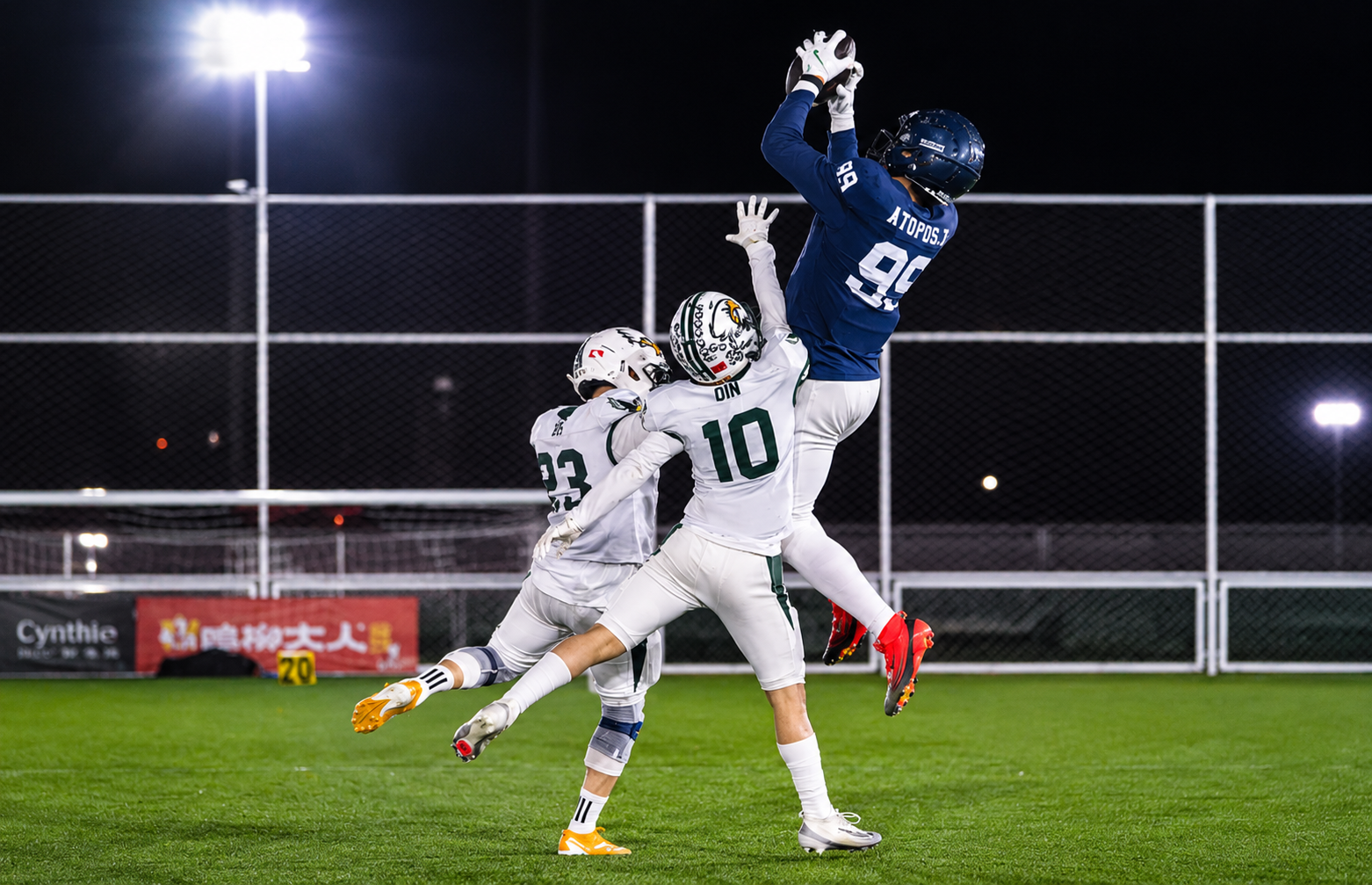
Barbarians receiver outleaping defenders for the ball
Before their quarterfinal elimination, the Beijing Barbarians had produced one of the most extraordinary games of the postseason, defeating the Shenzhen Kunpeng 38–35 in overtime.
A year earlier, the Barbarians had suffered a convincing 29–7 Round of 16 defeat against another Shenzhen team, the Shenzhen Buffaloes, in a 3 p.m. game in Beijing.
This time, they attempted to turn the weather into a home-field advantage.
With daytime temperatures in Shenzhen reaching 28°C (82°F), compared with approximately 10°C (50°F) in Beijing, the Barbarians scheduled the game for 6 p.m., hoping the colder evening conditions would trouble their warm-weather opponents.
The strategy initially appeared successful.
The Barbarians built a 21–7 lead before Kunpeng quarterback No. 12 Li Mengda (黎梦达) connected on a long touchdown pass to reduce the deficit.
An interception by the Shenzhen defense then set up another quick touchdown, tying the game at 21–21.
Beijing responded through wide receiver No. 99 Hu Jingdi (胡静笛), who used his 192-centimeter (6-foot-4) frame to outmuscle the Kunpeng secondary for his second touchdown of the half, giving the Barbarians a 28–21 halftime advantage.
Hu struck again after the break, scoring his third touchdown to extend the lead to 35–21.
At that point, the Barbarians appeared firmly in control.
But the game took a dramatic turn.
Two Shenzhen field goals reduced the deficit to 35–27 before Barbarians quarterback No. 31 Xu Jiafeng (徐佳锋) began an extraordinary sequence of turnovers.
Xu threw interceptions on consecutive possessions, allowing the Kunpeng to score a touchdown with fewer than five minutes remaining. A successful two-point conversion tied the game at 35–35.
A third consecutive interception on Beijing’s next possession, with fewer than two minutes remaining, appeared to give Shenzhen the opportunity to complete the comeback.
However, an excessive celebration penalty following the interception pushed the Kunpeng out of field-goal range, forcing them to punt.
Xu’s desperation Hail Mary on the final play of regulation was also intercepted, giving him four consecutive interceptions and five for the night, despite having thrown four touchdown passes.
The game headed to overtime with momentum seemingly favoring Shenzhen.
Instead, the Barbarians produced the decisive defensive play.
After losing the turnover battle during regulation, Beijing recovered a Kunpeng fumble on Shenzhen’s overtime possession, leaving the home team needing only a field goal to win.
The Barbarians missed their initial attempt, seemingly handing Shenzhen another lifeline. But a penalty gave Beijing a second opportunity, and this time the kick sailed through.
The improbable 38–35 victory sent the Barbarians into the quarterfinals, where their playoff journey came to an abrupt end against the surging SuXi Marauders.
Chengdu Pandaman emerge as West’s last remaining team
The Chengdu Pandaman reached the quarterfinals with an emphatic 37–7 victory over the Shanghai Hawks, emerging as the West’s lone remaining representative.
Quarterback No. 2 Aaron Feaver directed the Chengdu offense, throwing for 156 yards and two touchdowns.
Wide receiver No. 85 Wang Zhipeng (王智鹏) and running back No. 57 Tang Xiang (唐翔) added rushing touchdowns as the Pandaman overwhelmed the Hawks defense.
The visitors’ only touchdown came on a rushing score from quarterback No. 1 Ma Jinhui (马锦晖).
With the Xi’an Panthers, Jinan Mammoths and Wuhan Spicy all eliminated, Chengdu carried the West’s remaining championship hopes into the quarterfinals.
However, their postseason ended against a familiar opponent.
The defending champion Beijing Cyclones, who had dismantled the Pandaman 54–12 in last year’s quarterfinals, once again proved too strong, recording a 36–23 victory to advance.
Shenzhen Buffaloes survive offensive shootout before quarterfinal exit
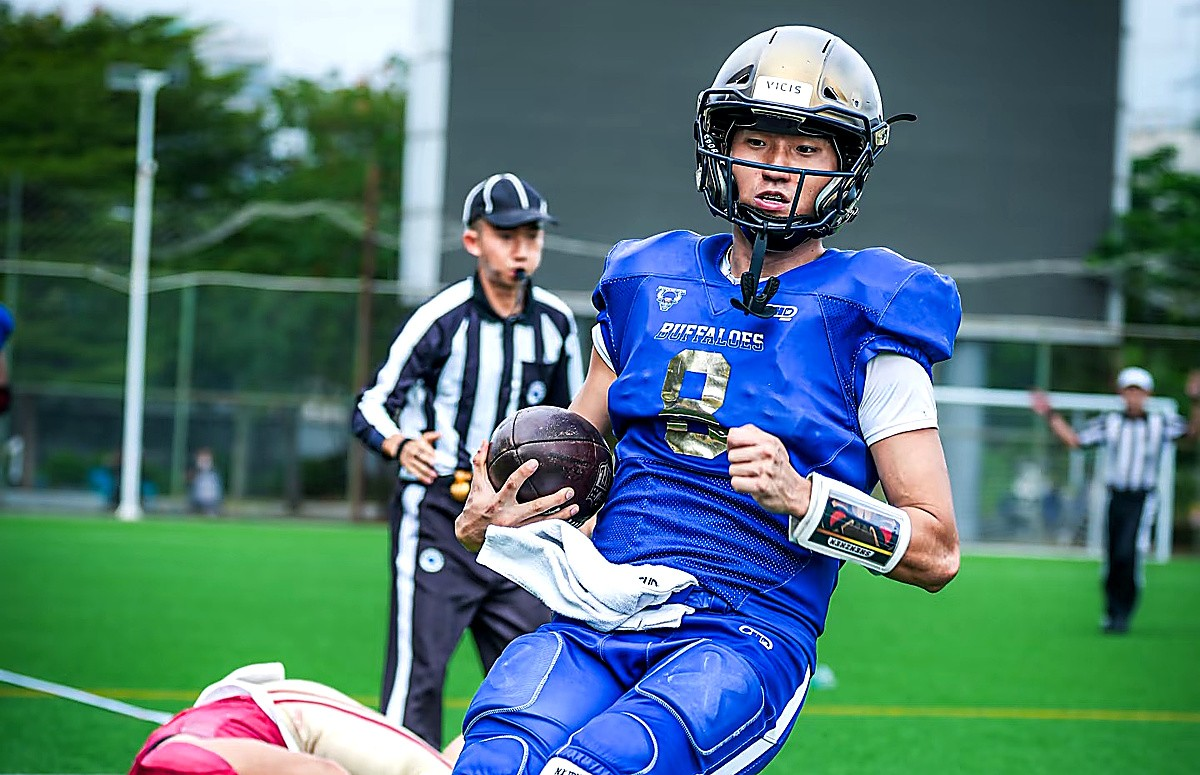

The Shenzhen Buffaloes reached the quarterfinals after surviving a determined challenge from the Shijiazhuang Liberators, pulling away late for a 50–40 victory in one of the highest-scoring games of the Round of 16.
Despite bringing just 24 players on the lengthy journey from Hebei Province to Guangdong Province, the Liberators pushed the home team throughout an entertaining offensive battle.
Both quarterbacks delivered outstanding performances.
Buffaloes quarterback No. 8 Shen Yan (申焱) threw four touchdown passes, while Liberators quarterback No. 3 Liu Shuai (刘帅) matched him with four touchdown throws of his own.
Shenzhen led 21–12 at halftime and appeared to be taking control after extending its advantage with a third-quarter touchdown.
But Shijiazhuang refused to disappear.


The Liberators repeatedly answered Shenzhen’s scoring drives and eventually reduced the deficit to just two points in the fourth quarter, threatening to pull off a major upset.
However, the visitors could not complete the comeback.
A pair of late touchdowns from the Buffaloes finally created some breathing room, allowing Shenzhen to secure the 10-point victory.
Their postseason ended in the quarterfinals, however, when the Shanghai Warriors held them to just six points in a convincing 27–6 victory.
Hong Kong Combat Orcas dominate Round of 16 before narrow defeat
The Hong Kong Combat Orcas produced the most lopsided result of the Round of 16, crushing the Shenyang Thunders 57–0 behind a dominant passing performance.
Quarterback No. 15 Zheng Zhisheng (鄭智升) threw five touchdown passes, four of them to wide receiver No. 0 Zahir Wilder.

A former Montclair State Red Hawks player, Wilder made history during his college career as the first player in Montclair State history to score as a passer, receiver, defender and returner.
The Thunders, who traveled to Hong Kong with just 22 players, had no answer for the Combat Orcas’ passing attack.
The victory set up a quarterfinal rematch with the Shanghai Wolves, who had defeated Hong Kong 8–0 in the same city during the previous postseason.
Although the Combat Orcas produced another outstanding defensive performance, they ultimately fell 14–9, ending their championship hopes.
Shanghai Wolves’ offense overwhelms Wuhan Spicy
Before their narrow quarterfinal victory over Hong Kong, the Shanghai Wolves had delivered one of the Round of 16’s most convincing offensive performances, defeating the Wuhan Spicy 40–20.
Quarterback No. 3 Matthew Smith led the way, throwing four touchdown passes and rushing for another as the Wolves controlled the contest from start to finish.
Wuhan found some success through its passing combination of quarterback No. 17 Li Chongyu (李崇瑀) and wide receiver No. 14 Cha Kesi (查柯斯).
The pair connected for 178 of Wuhan’s 186 passing yards, with Li throwing two touchdown passes.
However, the Spicy struggled to contain Shanghai’s explosive offense, and the Wolves were never seriously threatened as they cruised into the quarterfinals.
Travel demands highlight challenges facing China’s amateur league
Beyond the dramatic finishes and impressive individual performances, the playoffs have highlighted one of the defining challenges facing the Chinese National Football League: the enormous distances teams must travel in an amateur league.
Six of the eight visiting teams in the Round of 16 arrived with fewer than 30 players.
The Jinan Mammoths and Shenyang Thunders each traveled with 22 players, while the Shijiazhuang Liberators brought 24, the Gan Cavalry 25, the Shanghai Hawks 26 and the Wuhan Spicy 28.
The Shenzhen Kunpeng traveled with 30 players, while the SuXi Marauders brought a comparatively large roster of 44.
Significantly, the Marauders were the only visiting team to win in the Round of 16.
Their subsequent quarterfinal victory in Beijing reinforced their reputation as the postseason’s most successful road team.
The results illustrate how travel demands, roster availability and home-field seeding can influence playoff outcomes in a league where players must balance football commitments with their everyday responsibilities.
CNFL semifinals set for December 12
With the quarterfinals complete, four teams remain in contention for the 2026 Chinese National Football League championship.
The December 12 semifinals will feature the defending champion Beijing Cyclones against the Shanghai Wolves, while the Shanghai Warriors face the SuXi Marauders.
The Cyclones and Wolves will renew a postseason rivalry after meeting in last year’s semifinals, while the Warriors will attempt to end SuXi’s remarkable run of road victories.
For the Marauders, the opportunity is particularly significant.
After entering the postseason without having previously reached the quarterfinals, they have now advanced to the final four through three consecutive away victories, the first two secured in dramatic fashion and the third by an overwhelming margin.
The winners of the December 12 semifinals will advance to the CNFL championship game on January 9, when China’s American football champion will be crowned.