
Justin Pugh’s Italian Job starts with doing the homework
John Mahnen | American Football | 09/07/2026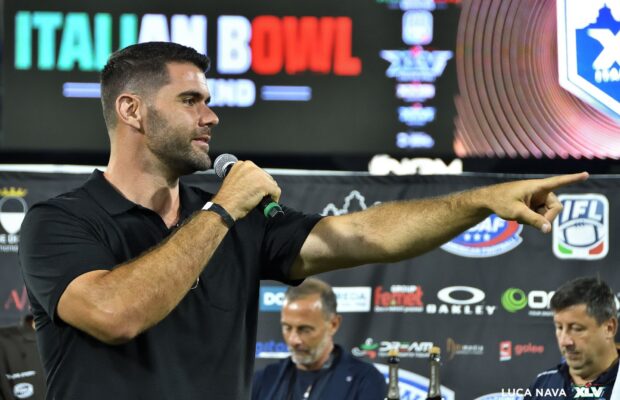
Since February 27, 2026, former New York Giants and Arizona Cardinals offensive lineman Justin Pugh has served as commissioner and international ambassador of the Italian Football League. The 2013 first-round draft pick arrived with an 11-year NFL résumé, but his role is about far more than attaching a recognizable name to the IFL. Pugh has been tasked with helping Italian football strengthen its international relationships, improve its presentation and create opportunities for its clubs and players beyond Italy.
From the Colosseum to Italian football
Justin Pugh’s route to the Italian Football League did not begin with a press conference, a glossy presentation or even a football game. It started with the Colosseum.
As a boy growing up in Pennsylvania, Pugh was fascinated by Rome and its gladiators. His first trip to Europe, while at Syracuse University, was made specifically to see the Colosseum. Years later, he married into what he describes as a loud and proud Italian-American family, spent his honeymoon travelling through Italy and met a former World League player in Milan who introduced him to the country’s long, occasionally glorious and too often overlooked American football history.
That meeting led him to John Grisham’s Playing for Pizza. From there, Pugh went down the rabbit hole.

Photo: New York Giants
Doing the homework first
There are plenty of former NFL players who lend their name to a project. What stands out about Pugh is the amount of homework he did before lending anything at all. He spoke with Oliver Luck, Will Wilson, Alistair Kirkwood and Mark Waller, among others, to better understand the successes and failures of the World League and NFL Europe. He studied Italy’s football history, the domestic structure, the stadium problem, the NFL’s international plans and the opportunities created by Olympic flag football and American college football.
His original dream was a rather romantic one: help bring an NFL game to Rome, somewhere within sight of the Colosseum. The practicalities of Italian stadiums and politics soon brought that idea back to earth, at least for now. He then looked at placing an Italian team in a pan-European competition, but the uncertainty surrounding that landscape convinced him there was more sense in building from within Italy first.
A different kind of commissioner
That decision eventually brought him into contact with FIDAF and the IFL. The timing was good. The First Division was reorganizing its commercial operation, and Pugh accepted the role of commissioner shortly before the 2026 season. He has since been working lockstep with FIDAF and says his experiences with the federation, league officials, clubs and many of the people involved in Italian American football have been overwhelmingly positive.
Pugh is also refreshingly clear about what the title means. He is not Italy’s version of Roger Goodell. Competition rules, discipline and the technical side remain with FIDAF and the league’s established structures. His role is focused on strategy, international relationships, partnerships and opening doors which have usually remained closed to the Italian game.
Pugh, of course, comes with a few doors already in his contact list. The former Syracuse offensive lineman was selected 19th overall by the New York Giants in the 2013 NFL Draft and spent 11 seasons with the Giants and Arizona Cardinals. In 2023, after returning to New York, he delivered one of the more memorable player introductions on Sunday Night Football: ‘Justin Pugh, straight off the couch.’
Now retired, Pugh is once again coming off the couch, although this Italian Job has required considerably more preparation. It also allows us to squeeze Syracuse into an Italian Job, which feels like something a scriptwriter should have managed long ago.
Building pathways players can see
His most insightful point may be that the case for playing American football in Europe has fundamentally changed. NFL Europe largely offered American players another chance to reach the NFL. For a young European, however, the path was remote and difficult to imagine. Today, Pugh believes Italian football can offer youngsters two much clearer destinations.
The first is flag football and the possibility of representing Italy at the Olympic Games. The second is the American college system. A talented Italian player may be able to earn an education, develop inside a high-level program and take advantage of opportunities that barely existed a few years ago. Reaching the NFL remains the longest of long shots, but reaching a university in the United States is a realistic and potentially life-changing goal.

Photo: La Repubblica
‘You have to build pathways that people can fantasize about,’ Pugh said.
That is more than a good quote. It is a useful way of looking at growth. Pugh used his own family as an example. When one child begins playing, parents become involved, then grandparents, cousins, friends and neighbours. The sport builds an audience one player and one family at a time.
Italy has an advantage here which other European countries do not. The game drew crowds in the tens of thousands during its boom years in the 1980s. Many of those players and supporters are now fathers, grandfathers and uncles. Give the next generation a reason to play, and Italian football may also reawaken part of its old audience.
Milan becomes the proving ground
Milan will be Pugh’s most visible test. The Seamen Milano and Rhinos Milano are being combined into one organization which will include senior tackle football, youth teams and flag programs. A new identity is being developed ahead of the 2027 season. The aim is not simply to put a stronger team on the field, but to build a complete football organization with development, media and transatlantic connections.
Pugh is particularly interested in the youth pathway. He would like the strongest Italian under-19 programs to move to full 11-man football and wants Italian players to progress from club football to national-team programs, the NFL Academy and American colleges. Rather than discovering a great athlete at 28 and teaching him the sport from scratch, why not find him at 15 or 16 and allow football to grow with him? It sounds obvious once somebody says it, which is often the mark of a worthwhile idea.

A five-year vision for the IFL
Five years from now, Pugh wants clubs that can function sustainably, common standards across the First Division and broadcasts people actually want to watch. He wants proper scoreboards, good game presentation and organizations with enough support that everything does not fall upon the same small group of volunteers. Most of all, he wants Italian players moving into American colleges every year, creating visible examples for the youngsters following behind them.
He is equally aware that Milan cannot flourish on its own. A flagship needs a healthy league and credible opponents. His vision therefore depends upon progress throughout the IFL, not merely one powerful team in Italy’s most internationally recognizable city. In time, he would like Milan to return Italian club football to wider European competition, but only after solid foundations have been built at home.
Big dreams, practical steps
There are larger dreams in the background: an NFL game in Italy, stronger ties with the United States, Olympic success in flag and perhaps even a Playing for Pizza film. Some may happen and others may not. What Pugh has done well so far is connect those dreams to practical steps involving youth football, education, better league standards and cooperation with the people already in place.
Time will tell, as it always does in European American football. First impressions, though, are that we could use a few more Justin Pughs throughout Europe. And yes, that is a very subtle dig at some of the characters this sport has attracted and still seems to attract. Pugh has arrived with ambition, but also with curiosity, respect and an impressive amount of homework already completed. That is added value Italian football can use.

HEADLINES
-
Advertisement
-
Advertisement