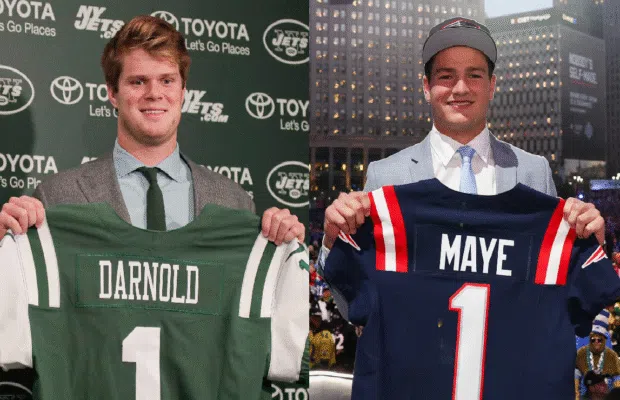
In many ways, Maye’s story is the inverse of Darnold’s. Sure, both were top picks — in fact, both went third overall (six years apart) to a team in the AFC East. But their paths couldn’t be more different from there.
Maye landed with New England, a bygone era’s ruler that was struggling to find its identity in the present. As a rookie, he began the regular season on the bench behind veteran Jacoby Brissett. But once Maye took over in Week 6, the young signal-caller quickly showcased enticing ability. Amid the dysfunction that preceded coach Jerod Mayo’s firing, Maye gave Patriots fans renewed reason to follow their team. In 2024, the only thing that mattered to them was Maye’s development.
Over the course of 13 games (12 starts), Maye demonstrated plenty of encouraging progress. He was an accurate passer who didn’t allow the speed of the game to overwhelm him, even while playing behind a leaky offensive line. He was eager to use his legs as a scrambler, racking up 421 rushing yards and two touchdowns on just 54 attempts, giving him a robust average of 7.8 yards a pop on the ground. By the end of Maye’s debut campaign, it was evident New England had a quarterback to build around.
Then, Mike Vrabel arrived.
The Patriots legend-turned-sideline savior instituted a culture of organization, discipline and accountability that meshed perfectly with the collection of youngsters and veterans brought in by New England’s front office. In one offseason, Maye welcomed in the likes of Stefon Diggs, Mack Hollins, Garrett Bradbury and Morgan Moses, plus rookies TreVeyon Henderson, Kyle Williams, Will Campbell and Jared Wilson, injecting talent into what was once a woefully undermanned offense.
From there, Maye and Josh McDaniels — who returned last January for a third stint as Patriots offensive coordinator — were off and running. After a bitter Week 1 loss to the Raiders (a true stunner in hindsight), Maye became the most efficient passer in the NFL by spreading the ball among a collection of pass catchers that included Diggs (team-high 1,013 receiving yards), Hunter Henry (team-high seven TD receptions), breakout playmaker Kayshon Boutte, Hollins, holdover DeMario Douglas and others. Maye even developed an occasional, explosive connection with Williams while powering the NFL’s third-ranked offense (and fourth-ranked passing attack).
Maye truly landed on the league’s radar, however, because of his willingness to air it out. His favorite downfield target became Boutte, the recipient of five deep-target touchdowns (20-plus air yards), including the playoffs. Boutte finished the regular season with the fourth-highest mark in yards per catch (16.7) and currently produces an absurd 140.6 passer rating on deep targets (postseason included). It’s an incredibly explosive and productive pairing made possible by Maye’s composure, arm strength and accuracy, and Boutte’s nose for hauling in deep strikes.
While Maye-to-Boutte connections filled highlight packages, the quarterback routinely posted incredible completion percentages. The 23-year-old actually just became the youngest player in the Super Bowl era to lead the NFL in completion percentage (72.0). He posted the second-highest passer rating by a QB age 23 or younger (a league-best 113.5), trailing only Patrick Mahomes‘ 2018 mark (113.8), and he broke Tom Brady’s franchise record by posting a 100-plus passer rating in 14 games (including playoffs).
There are plenty of reasons Maye is a strong MVP candidate. We’ll see if he can use his preternatural skills to power the Patriots to a seventh Lombardi Trophy.