
Italy storms back in Florence to stun Israel in U19 European thriller
By John Mahnen
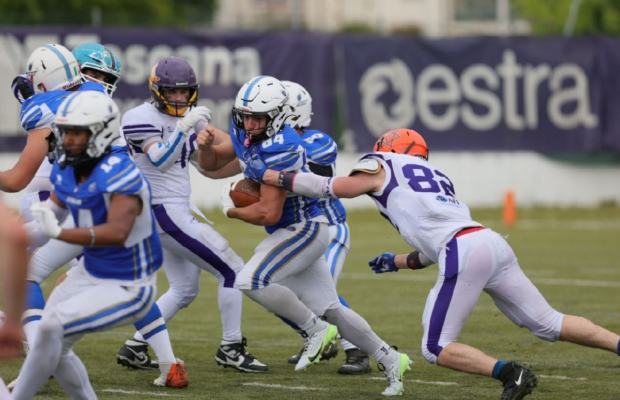
Italy’s U19 national team delivered one of the most dramatic performances of its recent history on Sunday in Florence, rallying from an 11-point second-half deficit to defeat Israel 32–28 in IFAF U19 European Championship qualifying action at the Guelfi Sport Center.
The victory did more than produce a memorable afternoon of football. It also had major implications for international play. Italy mathematically secured qualification for the 2027 IFAF U19 European Championship finals and, according to FIDAF, achieved its first-ever promotion into Europe’s top U19 group. For a young Italian side that had watched a 14–0 lead turn into a 28–17 hole, the result was a statement of resilience, composure and competitive maturity.
Italy starts fast
Italy’s Coach Giorgio Longhi could hardly have asked for a better opening. Quarterback Sergio Marzullo and the Italian offense moved the ball effectively on the first drive, with running back Guido Iddas setting an early physical tone and Gioele Schiavoni making a strong contested catch. Although the drive stalled near the Israeli red zone, Italy’s special teams soon provided the breakthrough.
After the defense forced a punt, Federico Bassi fielded the kick and turned the sideline into a runway, racing back for the game’s first touchdown. Alessandro Gotti added the extra point, giving Italy a 7–0 lead and immediately rewarding the special teams work drilled during the Azzurrini’s preparation camp.
The defense, coordinated by Mauro Solmi, kept Israel quiet early, with Giorgio Benedetti, Giovanni Martinello and the Italian front limiting the ground game and pressuring quarterback Michael Arbel. Italy then doubled the advantage when Marzullo found Karim Desmet Diop on a well-designed surprise concept. Diop, playing on his home field as a Guelfi Firenze product, hauled in the touchdown to make it 14–0.
Israel flips the game
What looked like an Italian-controlled afternoon quickly became a contest of nerves. Israel answered in the second quarter after Joshua Smilovitz intercepted Marzullo, giving Arbel and the Israeli offense the spark they needed.
Arbel began finding rhythm through the air, connecting with Max Eisenberg for Israel’s first score. Boaz Klein then punished Italy on the ground, cutting through the defense for another touchdown. By halftime, Nathaniel Fried had added a third Israeli score, completing a 21-point second quarter and sending Israel into the break ahead 21–14.
Italy’s problems were not limited to Israel’s execution. Penalties, missed assignments and stalled drives disrupted the Azzurrini’s rhythm. Yet the first-half collapse also created the central question of the game: could Italy regroup after seeing its early dominance vanish?
Belli sparks the response
The answer began with Leonardo Belli. The young Ancona Dolphins defensive back, born in 2009 and making a major impression on the international stage, read an Israeli route perfectly in the third quarter and intercepted Arbel. It was the kind of defensive play Italy desperately needed, turning emotion and field position back toward the home sideline.
Italy converted the turnover into points. The drive stalled short of the end zone, but Gotti calmly kicked a field goal to cut the deficit to 21–17.
Israel responded like a team unwilling to let the game slip. Arbel found Kozadayev on a deep strike through the Italian secondary, restoring Israel’s control at 28–17. At that point, Italy needed two scores and a defensive stand. Instead of fading, the Azzurrini found their identity again.
Iddas and Diop lead the comeback
The comeback ran through Guido Iddas. The Milano Seamen running back became the engine of the Italian offense, grinding out yards, breaking tackles and forcing Israel to defend every gap. With Bassi again flipping field position on a dangerous punt return, Italy marched into scoring range.
From short yardage, Italy powered the ball over the line to cut the gap. Then came one of the game’s defining calls: a two-point conversion to Diop, left free on the back side of the formation. The conversion made it 28–25 and turned a two-score deficit into a one-possession fight.
In the fourth quarter, Italy’s defense tightened. Alessandro Framarini made key tackles. Gerolin batted passes at the line. Martinello added pressure. Even after another Marzullo interception threatened to derail the comeback, a “sanguine” moment according to the commentator Paolo Belvederesi, the defense refused to break.
Given another chance, Italy leaned again on Iddas and the offensive line before Marzullo returned to Diop. The Guelfi receiver did the rest, slipping tackles and fighting into the end zone for the go-ahead touchdown. Gotti’s kick made it 32–28 Italy.
Bassi closes the door
Israel still had time, and Arbel still had Kozadayev, the most dangerous connection in the Israeli offense. But Italy’s defense held firm in the final minutes. Alfredo Cacciali made a crucial tackle short of the marker, Gerolin disrupted another passing lane, and Israel faced a decisive late fourth down.
Then Bassi, already the game’s special teams hero, became the closer. Reading the route, he stepped in front of the pass for the interception that sealed the game. Italy kneeled out the clock, completing a 15–0 finishing run and a 32–28 victory.
For Israel, Arbel, Kozadayev, Fried, Eisenberg and Klein all showed quality in a performance that pushed Italy to the limit. But the day belonged to the Azzurrini.
A result with European consequences
The win puts Italy in control of its IFAF U19 European path. With Israel already having received a forfeit win over Sweden, Italy’s victory in Florence gave the Azzurrini the decisive result they needed to secure the group and book their place among Europe’s elite for the 2027 finals.
That makes the September 19 matchup with Sweden important, but no longer decisive for Italy’s qualification. The bigger picture is clear: Italy U19 has taken a significant step up in the European youth hierarchy.
Behind Bassi’s all-around brilliance, Diop’s clutch scoring, Iddas’ relentless running and a defense that found its answers when it mattered most, Italy turned a dangerous collapse into a landmark comeback. Florence witnessed a thriller, and Italian youth football took a major step forward.