
BD Kennedy still answering the call after nearly 40 years
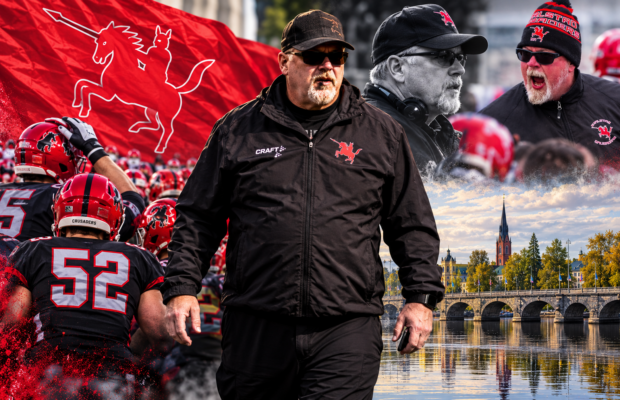
Billy “BD” Kennedy has spent nearly four decades coaching football, more than half of them in Sweden, but the game still has a way of bringing him back to where his European journey began.
Nearly 25 years after first taking charge of the Carlstad Crusaders, Kennedy is preparing for a third stint at the helm of one of Swedish football’s most successful clubs. This time, he will double as offensive coordinator after spending the last three seasons coaching the offensive line.
For a coach whose fingerprints can be found all over the Swedish game, from Arlanda to the national team, there is something fitting about another chapter beginning in Karlstad.
From Oklahoma to Karlstad
Kennedy was hardly a coaching novice when he arrived in Sweden in 2002. The Oklahoma native had already spent 15 years on American sidelines, including stops as a graduate assistant at Baylor University, offensive line coach at Hutchinson Community College and 11 seasons coaching the offensive line at Washburn University.
His first three seasons with the Crusaders produced three consecutive Swedish championship game appearances, while the breakthrough on the international stage came in 2003 when Carlstad captured the EFAF Cup with a victory over the Tyrolean Raiders in Austria.
What followed was supposed to be a new chapter elsewhere, but Kennedy never strayed far from the Swedish football landscape.
From 2005 through 2012, he served as head coach of the Arlanda Jets, guiding them to the Swedish championship game in 2008. He eventually returned to the Crusaders, serving in a variety of roles before beginning his second stint as head coach in 2019. That run included a Swedish championship in 2020.
The decision that eventually brought Kennedy to the Crusaders actually began with a promise to his wife: if the family was going to move to Sweden, he wanted to continue doing what had already been such a large part of his life in the United States — coaching football.
What neither of them could have known was just how enduring that decision would become, or how deeply Kennedy would eventually become connected to one Swedish football club.
“First, I told my wife when she asked about moving to Sweden, that I would do it as long as I could coach football (that is what I had been doing the previous 15 years in the US and the first 8 years of our relationship). Little did I know that I would always have to have another job so that I could coach, but it is a part of the deal with my wonderful wife.
Also, The Crusaders is a very special organization and a place that has always felt like home. I have coached every age group, I have coached some of the Senior players since they were in U11. I am even coaching son’s of some of the original players that I coached when I first came to Karlstad. Coaching, for me, is a calling. I truly enjoy the process and am grateful that I am able to continue to give back to the game and continue to learn from the game and be at a special place such as the Carlstad Crusaders.”
An offense built to fit
Kennedy’s return to the top job will also put the offense directly in his hands.
He has spent the past three seasons working with a Carlstad offensive line that helped power one of the most productive attacks in the Swedish Superserien. Rather than arriving with a new playbook determined to put his own stamp on things, Kennedy intends to first determine what best suits the roster.
“The most important part of the process is fitting the plan to the personel. Christian Forsman did a fantastic job with that and I also believe that “if it’s not broken, then don’t fix it.” We will see how all the pieces fall together in regards to building the team and recruiting, then we will build and offense that allows us to put our players in the best position to be successful.”
A view from across Swedish football
Kennedy has watched the Swedish game evolve from more than one vantage point.
His eight seasons with Arlanda provided a perspective outside Karlstad, while his work with Team Sweden allowed him to coach the country’s best players regardless of club affiliation.
Kennedy served as offensive coordinator when Sweden won the 2005 European Championship and was national team head coach in 2007. He returned to the job in 2019 and guided the Swedes through victories over Russia, Great Britain and Finland to reach the 2021 European Championship final.
By the time his second national-team tenure ended in 2023, Sweden had won six of nine senior internationals under Kennedy.
Yet for all that has changed since 2002, he sees a remarkably familiar formula for building a championship-caliber club.
“Actually the process is much the same. It is about developing your ‘home grown’ talent. If you have a solid youth organization that continually sends players “up the chain” then you have the opportunity to have a high level of local or your own talent. Then the process is building around those players with new players (Swedish) and also filling the gaps with the import players. If you have a solid base of Swedish players, then you are not dependent on “import support” to be successful. Instead, it all fits together to make the most competitive team possible.”
Winning through your amateurs
Long before the European game began attracting the level of international talent it does today, Kennedy developed a simple maxim for success on the continent: “you win through your amateurs.”
His years with Arlanda, Team Sweden and the Crusaders have done little to alter that belief.
“Yes, I still believe that. The better you develop you own talent (from youth all the way up to a rookie adult player) the better chance you have to be successful. It is one of the key areas for success in my opinion. You can’t just bring in an American QB and expect him to just ‘be great because he played in college’. Football is the ultimate team game where every individual must perform their special talent that only they can do, in order for the team to be successful. So I believe that success starts with the development of your local talent and that is one of the things that has help the Crusaders win on a consistent basis.”
That philosophy takes on a different meaning when viewed across Kennedy’s entire Swedish career.
He has coached the country’s elite players with Team Sweden, spent eight years trying to beat the Crusaders while running Arlanda, and worked with virtually every level of the organization in Karlstad. Today, he is even coaching the sons of players he first encountered more than two decades ago.
The uniform may change and the talent may come from different places, but Kennedy keeps returning to the same conclusion: European football is ultimately built from the ground up.
For the next chapter of the Carlstad Crusaders, so will his team.