NFL Madrid is no longer a novelty — now comes the real test
The second NFL Madrid Game drew another full house, better football and an enthusiastic response from the Spanish press. The novelty has survived. Now comes the harder part: turning an annual American spectacle into something that belongs to Spain.
If the first NFL Madrid Game was an introduction, the second was the follow-up date when both sides discovered whether there was anything behind the expensive dinner and fireworks.
According to the Spanish press, there was.
The Cincinnati Bengals’ 34-17 victory over the Atlanta Falcons was almost secondary to the broader verdict delivered Monday morning. The NFL’s second visit to the Santiago Bernabéu was described as a confirmation, a consolidation and, in the more excitable corners of the press box, proof that Madrid has become one of the league’s European capitals.
That may be laying the chorizo on a little thick, but the evidence is encouraging.
A second sellout confirms Madrid’s appeal
The announced attendance was 78,660, exactly 50 more than the inaugural game between the Miami Dolphins and Washington Commanders. It is difficult to claim explosive growth based on enough additional people to fill a medium-sized bus, but filling the Bernabéu for a second consecutive year matters more than the extra 50.
The first game had novelty. The second had to survive without it.
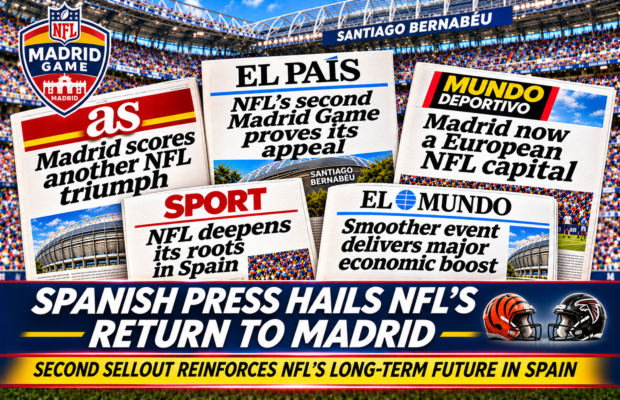
AS gave the event its front page and declared that Madrid had enjoyed “an ode to football.” Its central argument was that the 2025 game introduced the NFL to Spain, while the second edition created new supporters. The newspaper stressed that this was not merely another successful crowd. This time the product on the field also justified the packaging.
That distinction matters. Dolphins-Commanders delivered a close finish in 2025, but not necessarily three hours anyone would preserve for the Pro Football Hall of Fame. Bengals-Falcons brought Joe Burrow, Ja’Marr Chase, Tee Higgins and Bijan Robinson to Madrid and allowed them to behave like the stars advertised on the poster.
We will save the actual football for the game report. The important point here is that the NFL finally gave Madrid the whole package: recognizable players, offensive fireworks and a result that remained interesting long enough to keep everyone away from the tapas.
Spanish newspapers embrace the spectacle
AS columnist Jorge Noguera called the second edition evidence that the NFL’s Spanish project is becoming established. He also dismissed complaints that a substantial portion of the crowd had travelled from abroad. His argument was sensible: nobody checks passports before declaring a Real Madrid match a success, and Madrid does not become less Spanish merely because someone from Ohio has painted himself orange on the Paseo de la Castellana.
El País was slightly more measured. It noted that the anticipation around the city appeared less intense than in 2025, but that the reduced novelty had no negative effect on attendance. That may be the most valuable observation in all the coverage. The circus came back to town, everyone already knew what was in the tent, and nearly 79,000 still bought a seat.
Mundo Deportivo went further, declaring Madrid one of the NFL’s European capitals. The paper described the event as a “mini Super Bowl” and treated the crowd as validation of the league’s international expansion strategy.
Economic impact and a smoother operation
Sport added the figure that always makes politicians sit up straighter: an estimated economic impact of €70 million. AS had placed the impact of the 2025 game at approximately €71 million. Neither paper showed its work, and economic-impact estimates at major sporting events tend to arrive wearing shoulder pads of their own. Still, hotels, restaurants, airlines and bars certainly did not object to tens of thousands of supporters spending an NFL weekend in Madrid.
El Mundo offered the best view from ground level. It reported improved stadium access, fewer of the queues that irritated spectators during the first edition, more food trucks, more merchandise and enough hamburgers and nachos before noon to make Madrid briefly question its commitment to lunch.
There was even a short power failure near the end of the game. The NFL wanted an authentic American experience and apparently brought the infrastructure from an ageing AFC stadium as well.
An American spectacle with a Spanish identity
The presentation was carefully adjusted for the host country. Ja’Marr Chase celebrated a touchdown with a matador routine. Spanish football champions were honoured. Emergency workers received an ovation, and the victims of recent railway accidents were remembered. There were American fireworks, Spanish music and the required procession of athletes, celebrities and public officials.
The NFL was not simply unloading an American product and demanding that Spain admire it. It was making a visible effort to wrap the game in local culture, even if some of that wrapping occasionally looked as subtle as a souvenir shop at Madrid-Barajas Airport.
The challenge of building a lasting football culture
The most thoughtful pregame coverage came from El País, which interviewed NFL international-development director Patrick Long about the league’s search for players beyond the United States and Canada. Long discussed the International Player Pathway and the NFL Academy, and identified Spain as an increasingly important market.
That is where the keeper question becomes more complicated.
Madrid has demonstrated that it can host an NFL game. It has not yet demonstrated that the game is building a lasting Spanish football culture. A packed Bernabéu is not the same thing as stronger domestic clubs, more youth participation, better coaching or a Spanish-born and Spanish-developed player reaching an NFL roster.
AS supplied the only real note of caution by remembering the Barcelona Dragons and NFL Europe. That adventure created loyal followers but disappeared in 2007. Exporting a spectacle can attract an audience without creating a sustainable structure underneath it.
The NFL’s present strategy is smarter. It is bringing actual regular-season games instead of operating a separate European league, assigning Spanish marketing rights to NFL teams and using flag football as an accessible entry point before its Olympic debut in 2028.
So, is Madrid a keeper?
Yes.
The second edition proved that the first was not a one-night stand. The stadium filled again, the operation improved, the football was better and the Spanish press treated the event as something increasingly familiar rather than an exotic American invasion.
But the third edition will face a different test. The first game proved Madrid could attract curiosity. The second proved it could repeat the event. The next must begin proving that the NFL is creating something in Spain, not merely renting the Bernabéu once a year.
The circus will return in 2027. Madrid has earned that much.
Now the NFL has to leave something behind after the elephants, orange jerseys and €14 nachos have gone home.