American Jedi: The 9/11 story AFI readers should see
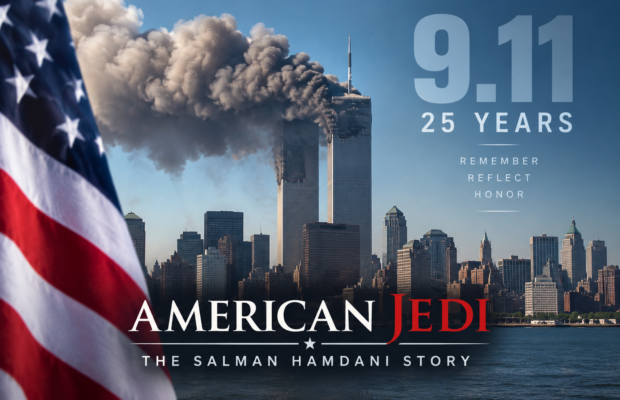
Twenty-five years after September 11, the images remain instantly recognisable. The smoke, collapsing towers and dust-covered people are part of our collective memory. But anniversaries can flatten history. Nearly 3,000 individual lives become a number and human stories become a familiar television montage.
One life behind the numbers
American Jedi: The Salman Hamdani Story does the opposite. The 38-minute documentary slows everything down and introduces us to one young man. For American Football International readers, the football connection begins behind the camera. The film was co-written and co-directed by Nick Eyde, an erstwhile import quarterback in Italy and Austria whose European football journey was considerably longer than the average American’s gap year.
Eyde played six Italian Football League seasons for the Rome Ducks, Reggio Emilia Hogs, Lazio Marines and Bolzano Giants, reaching an Italian Bowl. More importantly, he never really left Italian football. He spearheaded the effort that brought the Italian Bowl to Toledo, Ohio, in 2023 and 2025. Eyde understands the AFI world from the inside. He also recognised another football story belonged here: the road that made Robert Saleh the NFL’s first Muslim head coach began on that same terrible morning and teamed up with Michigan State professor Mohammad Khalil to produce American Jedi.
A brother escapes the South Tower
Saleh’s brother David was working for Morgan Stanley in the South Tower when the first aircraft struck the North Tower. He saw the fireball and headed down, ignoring announcements that the second building was secure. He had reached roughly the 24th floor when United Airlines Flight 175 crashed into his tower. David escaped, but his family spent much of the day unable to contact him.
Robert Saleh was 22 and working in finance. For several hours, he believed his brother might be dead. David’s survival forced him to examine his own life. Coaching was the dream filed away under ‘someday’. September 11 removed that luxury. Saleh entered coaching at Michigan State in 2002, beginning a climb that included a Super Bowl with Seattle, the San Francisco 49ers and the New York Jets. In 2026, he is back in the big chair with the Tennessee Titans.
David Saleh appears in American Jedi as one of the survivors who gives the film its eyewitness perspective. He did not know Salman Hamdani; his connection came through another Morgan Stanley survivor interviewed by the filmmakers. Their experiences form parallel lines: David escaped the South Tower and changed Robert’s life; Salman went towards the danger and never came home.
Salman heads towards the danger
Hamdani was 23, a Pakistani American raised in Queens and apparently determined to fit several careers into one lifetime. A biochemistry graduate and Rockefeller University research technician, he was also an EMT and NYPD cadet. He hoped to attend medical school. He had played high-school football, sang in a Christian choir despite being a devout Muslim and was a serious Star Wars fan. ‘Jedi’ even appeared on his licence plate.
On September 11, Salman never arrived at Rockefeller. Although his exact movements cannot be reconstructed, the evidence indicates that he saw the burning towers and headed downtown to help. His remains, identification and medical bag were eventually recovered from the wreckage of the North Tower.
Suspicion follows tragedy
The cruelty did not end there. While Salman was missing, investigators and parts of the media treated his Pakistani background and Muslim faith as reasons for suspicion. His family was questioned about his travels, friends and decision to become a police cadet. Missing-person posters were torn down. A family searching for its son was effectively asked to prove that he belonged to the country for which he had just given his life.
Once the truth emerged, Salman received a police funeral with full honours and was recognised by Congress as an example of Muslim Americans who acted heroically that day. Yet his mother, Talat Hamdani, continued fighting for his recognition as a first responder. The film tells that story without turning Salman into a saint or political prop. He emerges as something more valuable: a bright, ambitious and occasionally quirky New Yorker who instinctively moved towards people who needed help.
Football provides the connection
That is why the Saleh thread matters. International football regularly celebrates the sport as a bridge between cultures. Sometimes that sounds lifted from a federation press release. Here it is real. Saleh’s Lebanese American Muslim identity was part of the life that shaped his football journey. His brother’s survival supplied the urgency, while Salman’s sacrifice shows the price paid by someone whose Americanness was questioned even in death.
American Jedi is not principally a football film, nor should it be. It is a family story about service, suspicion, grief and the defence of a young man’s good name. For AFI readers, David and Robert Saleh provide a meaningful way into it. We know where Robert’s coaching road led. This documentary reminds us where it began.
May the Force be with his memory
Twenty-five years on, set aside 38 minutes for Salman Hamdani. The Jedi comparison is not as fanciful as it sounds. In Star Wars, the Jedi move towards danger to protect others. On September 11, a football player, scientist, EMT and police cadet from Queens did exactly that. May the Force be with his memory.