
From Cologne to Houston: Marlin Klein keeps European NFL dream alive
By John Mahnen
The American football dream has always required a little imagination in Europe. For decades, young players in Germany, Austria, France, the Netherlands, Scandinavia of the UK could watch the NFL, fall in love with the sport and still wonder whether the road from a local club field to a professional stadium in the United States was really open to them. Marlin Klein has now supplied another powerful answer.
Klein’s Journey to the NFL
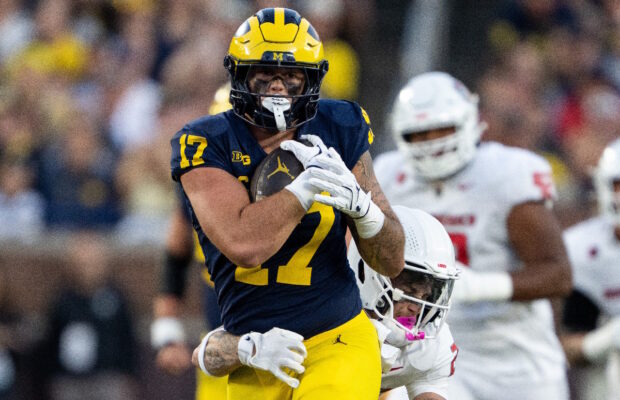
The Cologne native, who began his football life with the Cologne Crocodiles, was selected by the Houston Texans in the second round of the 2026 NFL Draft, 59th overall, after a college career at the University of Michigan. For a player who first had to cross the Atlantic simply to chase the game at a higher level, it was more than a draft pick. It was another validation of the European pathway.
A Unique Pathway
Klein’s route was not the old-school American football story. He was not raised in Texas, Florida, Ohio or Pennsylvania. He grew up in Cologne, first playing soccer and basketball before finding American football in the youth setup of the Crocodiles. From there, helped by Gridiron Imports, he earned a chance at Rabun Gap-Nacoochee School in Georgia before making the next jump to Ann Arbor, Michigan in 2022.
Success at Michigan
That journey alone would have been remarkable. But Klein did not simply collect a helmet and a scholarship. He became a Wolverine. He played in 35 games with 12 starts, developed behind elite talent, won a national championship with Michigan, earned All-Big Ten honorable mention, and was voted a team captain in 2025. The Texans’ own draft notes highlighted his 2023 CFP national title, three Academic All-Big Ten selections, 2025 captaincy and college career totals of 38 receptions for 364 yards and one touchdown.
Physical Tools and Potential
At 6-foot-6 and around 250 pounds, Klein looks the part. But what made him intriguing to NFL evaluators was not just size. NFL Network draft analyst Daniel Jeremiah had him among the Day 2 tight end prospects and noted that teams value tight ends who can play in-line, block, run, and still threaten downfield. Jeremiah also pointed out that Klein’s college production was affected by playing behind Colston Loveland, suggesting his profile might have been even bigger had he been Michigan’s featured tight end for several seasons.
The Texans’ Perspective
That is part of the appeal for Houston. Klein is not a finished product, but he arrives with physical tools, toughness and upside. The Texans selected him at No. 59 after returning to the Big Ten on Day 2 of the draft, describing him as a team captain and physical tone-setter. Texans analyst John Harris praised his willingness to “trade paint” with edge defenders, a revealing phrase for a player whose value may initially come as much through attitude and blocking as receiving statistics.
A Personal Connection
For Klein, the landing spot also felt personal. After being drafted, he said he had wanted Houston from the beginning, describing the Texans as a hard, physical football team and exactly the kind of organization he wanted to join. His message after the selection carried both joy and realism: the dream had become real, but the real work was only beginning.
The Demands of the NFL
That matters. The NFL does not hand out careers for good stories. Klein must now earn a role in an offense built around the erstwhile Ohio State quarterback C.J. Stroud and a franchise that has returned to playoff relevance. Tight end is a demanding position, especially for a player still relatively young in football years. He will have to block NFL edge defenders, learn protections, master route details and prove he can be trusted on Sundays.
A Significant Moment for European Football
Still, his selection is a significant moment for German and European football. Klein follows a line of transatlantic success stories that includes Sebastian Vollmer, Björn Werner, Markus Kuhn, Jakob Johnson, Efe Obada, Bernhard Raimann and others who showed that European-developed players can reach the league through different routes. Some came through college football. Some came through the International Player Pathway. Some switched sports. Klein’s path stands out because it began in the German club system and continued through one of college football’s most storied programs.
The Importance of Local Infrastructure
For the AFVD and the wider German football community, his rise is another reminder that local infrastructure matters. The Cologne Crocodiles did not produce an NFL-ready tight end overnight. They helped introduce a young athlete to the game. The next steps required ambition, family sacrifice, coaching, scouting, travel, language learning and years of adaptation. But without that first football home in Germany, the rest of the story might never have happened.
Inspiring the Next Generation
Klein has spoken openly about wanting his journey to mean something for young players back home. Before the draft, he said he wanted kids in Germany to understand that they can make it regardless of where they come from, who they are, what they are called or what they look like.
A Legacy of Hope
That may be the larger legacy of draft night. A boy from Cologne watched the NFL, left home, became a Michigan man and heard his name called by the Houston Texans in the second round. For every young European player practicing on a muddy club field and wondering whether the dream is too far away, Marlin Klein just made the distance look a little shorter.