
Line Shopping in Sports Betting: How Much Is It Really Worth?
Most bettors spend an hour on the pick and ten seconds on the price. That is backwards. The same bet, on the same line, is often priced differently at different sportsbooks, and over a season that gap can decide whether a winning bettor actually makes money.
The short answer: line shopping means checking several sportsbooks before every bet and taking the best price. In a four-book comparison this month, no single sportsbook had the best moneyline price on even half of all sides, and moving from -110 to -105 nearly tripled the profit of a 53% bettor over a 200-bet season.
Below is the data behind those numbers, the math you can run on your own bets, and a simple routine that takes under a minute per bet.
What is line shopping?
Line shopping is comparing the odds for the same bet across multiple sportsbooks and placing it wherever the price is best. Every book sets its own numbers. They react to their own customers, their own risk and their own oddsmakers, so their prices drift apart all day.
Sometimes the difference is the price, such as -110 at one book and -105 at another. Sometimes it is the line itself, such as a team at +3 in one place and +2.5 somewhere else. Either way, taking the better number costs you nothing and pays you more every time you win.
How often do sportsbooks disagree?
More often than most people assume. According to line-shopping data from BettingPicks, which compares MyBookie, Bovada, BetOnline and BetUS on every NFL, college football, NHL and MLB game, no single book had the best moneyline price even on most sides in early October 2026.

Share of moneyline sides where each book had the best price (ties count for every book that matched). Source: BettingPicks odds comparison, Oct 3–6, 2026.
| Sportsbook | Best moneyline price on | Average margin |
|---|---|---|
| BetOnline | 165 of 328 sides (50%) | 3.6% |
| BetUS | 144 of 328 sides (44%) | 3.8% |
| Bovada | 111 of 332 sides (33%) | 4.3% |
| MyBookie | 73 of 328 sides (22%) | 5.0% |
Even the book that led most often was best on only about half the sides. If you bet everything at one book, you are taking a worse price on roughly half your bets, every week, all season. If that one book happens to be the one with the highest margin, you are taking a worse price on nearly four bets out of five.
What the difference looks like on real bets
Here are three bets from the same week, each the same bet on the same line at two different books:

Profit on a $100 winning bet at the best and worst available price. Source: BettingPicks odds comparison, Oct 2026.
| Bet | Best price | Worst price | Profit on a $100 bet |
|---|---|---|---|
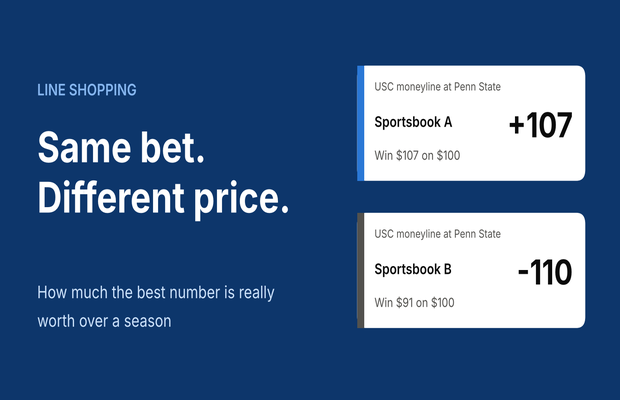
| USC moneyline at Penn State | +107 | -110 | $107 vs $91 |
| Eastern Michigan moneyline at Akron | -250 | -294 | $40 vs $34 |
| Rangers puck line -1.5 vs Islanders | +184 | +163 | $184 vs $163 |
The USC example is the clearest. At one book you are betting an underdog at plus money. At another, the same team is priced as a favorite. Same game, same side, a $16 swing on a single $100 bet.
The Eastern Michigan bet shows that favorites are not immune. Laying -294 instead of -250 means risking $44 more to win the same $100, or winning $6 less on every $100 staked. On heavy favorites, small-looking price gaps eat a big share of an already thin return.
The math over a full season
Small gaps compound. Take a bettor who places 200 bets a season at $100 to win and hits 53% of them, which is a good but realistic record.
- At -110 on every bet: 106 wins pay $10,600, and 94 losses cost $10,340. Profit: $260.
- At -105 on every bet: the same 106 wins pay $10,600, but the 94 losses cost only $9,870. Profit: $730.

Same picks, same wins, nearly three times the profit. The only change is the price. At -115, the very same record loses money.
Break-even win rates by price
Every price has a break-even win rate: the share of bets you must win just to get your money back. At -110 it is 52.4%. At -105 it is 51.2%. That 1.2-point cushion is often the whole difference between a winning and a losing season.
To work it out for any favorite, divide the price by the price plus 100. For -110, that is 110 ÷ 210 = 52.4%. For an underdog, divide 100 by the price plus 100. For +150, that is 100 ÷ 250 = 40%.

Margin: the cost hidden inside every price
Every price includes the book’s cut, often called the vig or juice. On a standard -110/-110 line, each side implies a 52.4% chance. Together they add up to 104.8%, not 100%. That extra 4.8% is the book’s overround, and it works out to the book keeping about 4.5% of the money wagered over the long run.
That cut varies by book. In the comparison above, average margins ranged from 3.6% to 5.0%. A book with a lower margin is not just occasionally cheaper. It is cheaper by design, on almost every market it prices. Over a few hundred bets, that difference alone can be worth more than a good week of picks.
Where line shopping pays the most
NFL spreads around 3 and 7
Around 15% of NFL games end with a margin of exactly 3 points, and about 9% end with exactly 7. That makes a half point on either side of those numbers far more valuable than a half point anywhere else. Getting +3 instead of +2.5, or laying -2.5 instead of -3, turns a large group of losses into pushes or pushes into wins.
College football
With 60-plus games on a busy Saturday, books cannot sharpen every line. Smaller-conference games in particular see wider gaps between books. Two of the three examples above are college games.
Underdogs and plus-money bets
Price differences are wider in plus money, so the gap per bet is bigger. On the Rangers puck line, the gap between the best and worst price was 21 cents, worth $21 on a $100 bet.
Props and totals
Player props and totals get less attention from oddsmakers than sides, so prices drift further apart between books. Prop bettors who do not shop are usually leaving the most money on the table.
Parlays
Parlays multiply every leg’s price together, so a small edge on each leg compounds. A three-leg parlay at -110 per leg pays about $596 profit on $100. The same three legs at -105 pay about $644. That is $48 more for the same three outcomes.
Line shopping and closing line value
The closing line is the last price before a game starts, and it is the most accurate price the market produces. Bettors who consistently get a better number than the close tend to win over time, because they are buying value before the market corrects.
Line shopping helps you beat the close twice. You get the best available number at the moment you bet, and you build a record of the prices you took that you can compare against the closing line later.
How to line shop without it taking over your life

- Open accounts at three or four books. Two is not enough to see the real spread of prices. Four gives you the best price on nearly every bet.
- Check every book before every bet. It takes under a minute with an odds comparison page.
- Log the price you took. Date, bet, book, price and stake. A simple spreadsheet is enough.
- Compare it with the closing line. Consistently beating the close is the best sign your process is working, even before the results show it.
Common line-shopping mistakes
- Betting at one book for a bonus. A one-time bonus rarely makes up for a worse price on every bet that follows.
- Only shopping the big games. The widest gaps are usually in smaller college games, props and totals.
- Ignoring the line and watching only the price. On spreads, +3 at -115 is often better than +2.5 at -105.
- Chasing a few cents at a book you do not trust. Fast, reliable withdrawals matter more than a slightly better number.
Line shopping FAQ
Is line shopping worth it for small bettors?
Yes. The gain is a percentage of every bet, so it scales with your stakes. A bettor staking $20 a game gets the same percentage improvement as one staking $2,000. Over a season, small stakes still add up.
How many sportsbooks do I need?
Three or four is the sweet spot. In the comparison above, no single book led on more than half of all sides, so each extra account meaningfully raises how often you get the best number.
Do sportsbooks limit bettors who line shop?
Some books limit customers who win consistently, especially those who regularly beat the closing line. Spreading your action across several books also spreads that risk, which is one more reason to keep multiple accounts.
What is a good price on a spread bet?
The standard price is -110. Anything at -105 or better is a good price on a spread or total, and some books offer reduced-juice lines on popular games. Taking -115 or -120 regularly is a sign you need to shop more.
Is line shopping legal?
Comparing prices is legal everywhere. Whether you can bet, and with which books, depends on where you live. Check your state’s rules before opening any account.
The bottom line
You cannot control whether a pick wins. You can control the price you take. Line shopping is the one edge every bettor can get, it costs nothing, and over a season it can be worth more than the picks themselves.
21+ only. Gambling problem? Call 1-800-GAMBLER.